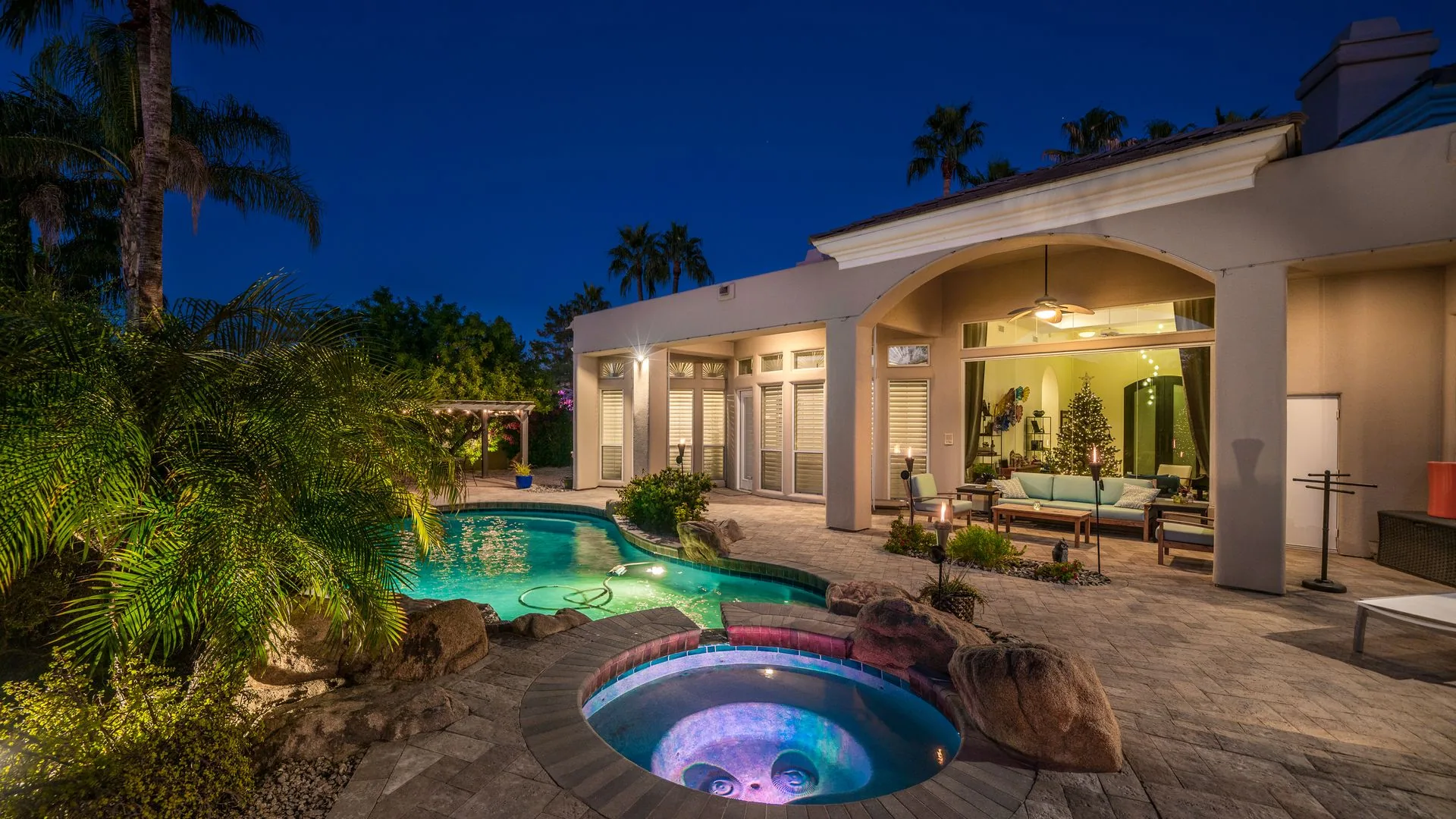
Landscape Lighting Ideas for a Stunning Phoenix Yard
August 18, 2026 · By Diamond Cut Landscaping

Landscape lighting ideas are one of the quickest ways to make your Phoenix yard feel finished after sunset. Out here, the best nights start when the heat lets up, and that is exactly when smart lighting earns its keep. You get a yard that is easier to walk, easier to entertain in, and a whole lot more inviting from the street to the back patio.
When we design lighting across the Valley, we are not trying to turn your yard into a spotlight show. We are aiming for a natural glow that fits the desert: warm tones on stone and stucco, soft guidance along pavers and decomposed granite, and a few well-placed accents that make your favorite plants look even better at night.
Why landscape lighting makes a big difference in Phoenix
Phoenix living happens later. In summer, you are outside when the sun goes down. In winter, you are outside because it finally feels perfect. Either way, lighting helps you use your space instead of staring at a dark yard through the back window.
- Comfort and usability: You can actually see seating areas, gates, and steps without pulling out a phone flashlight.
- Safety: Changes in elevation, pool deck edges, and loose gravel are easier to navigate.
- Security: A lit entry or side yard is simply less appealing to someone looking for an easy opportunity.
- Curb appeal: A warm, layered front yard reads as cared-for and intentional.
If you like the nuts-and-bolts side of how lighting is planned, professional landscape lighting planning guidance does a solid job explaining why placement and beam spread matter as much as the fixture itself.
The rule we follow first: light the focal point, not the fixture
The cleanest outdoor lighting never asks you to stare into a bulb. You should notice the palo verde canopy, the boulder grouping, the texture on your wall, or the way your pavers lead you to the patio. The fixture should stay in the background.
In a Phoenix yard, we often tuck uplights into planting beds where gravel can hide the body of the fixture, or we nest them behind the lip of a raised planter so you see the effect, not the hardware. That one choice is usually what separates a calm, high-end look from glare that bugs you and your neighbors.
Landscape lighting ideas for desert plants and specimen trees
Sonoran plants have built-in drama, but the good kind. Saguaros, ocotillo, olive trees, and palo verdes all have strong shapes that come alive when you give them a controlled uplight and let the shadows do their thing.
- Start a few feet off the base: Place the fixture about 2 to 3 feet from the trunk or cactus base, then tilt up until you see texture without turning the plant into a bright blob.
- Match the beam to the plant: Narrow beams for tall, vertical plants like saguaros and palms. Wider beams for broad canopies.
- Use two angles on multi-trunk trees: A second uplight from a different side softens harsh shadows and adds depth.
Lighting works best when the planting plan is designed with nighttime views in mind. If you are still deciding what goes where, our desert-appropriate landscape planting service helps you pick focal plants that look great at 5 p.m. and at 9 p.m.
Landscape lighting ideas for pathways, steps, and front entry safety
If you do one thing first, do this. Light the areas where people walk. Most “yard lighting regrets” come from skipping the practical stuff and jumping straight to accent lights.
- Give path lights room to breathe: In many Phoenix yards, spacing them about 6 to 8 feet apart creates a soft guide without the runway effect.
- Mark elevation changes clearly: Steps, landings, and raised planter edges deserve their own light, especially near pools and patios.
- Aim for the walking surface: You want light on the pavers or DG, not in your eyes while you are heading to the grill.
When we are building pavers or a new walkway, we like to plan lighting before the hardscape goes in so wiring routes and fixture pockets feel built-in. That is easy to coordinate during a hardscape installation, and it usually looks cleaner than trying to retrofit later.
Patios, pergolas, and outdoor kitchens: build your lighting in layers
Think of your backyard like a room. You would not rely on a single overhead light inside your home, and the same goes outdoors. Layering keeps the space comfortable and flexible.
- Ambient lighting: Soft downlighting under a pergola or gentle indirect light along a wall for conversation areas.
- Task lighting: Brighter, focused light where you prep food, grill, and serve.
- Accent lighting: A little pop on a textured wall, a column, or a favorite plant to keep the space from feeling flat.
If you are adding a structure, it is worth planning lighting at the design stage so wiring can be concealed and switch zones make sense. We often build that in when we design custom pergolas and shade structures for seating and dining areas.
Water feature lighting ideas that still feel natural in the desert
A fountain or spillway is already a focal point in Phoenix because it adds sound and movement. At night, the right lighting makes the water feel like part of the overall yard instead of a dark corner behind the patio.
- Light the movement, not the whole basin: A well-placed submersible LED can highlight the ripple and shimmer without looking like a swimming pool light.
- Add a little depth around the edges: A couple of low accents near boulders or a raised wall keeps the feature grounded and easy to see.
- Stay warm: Warm white usually looks more natural against desert stone than blue-white light.
If you want a quick visual sampler of how different outdoor features get lit, landscape lighting ideas for outdoor features is a helpful reference for brainstorming.
Warm LEDs, low glare, and low-voltage systems (what works best in Phoenix)
Desert materials can be unforgiving under the wrong light. Cool-white LEDs tend to make plants look dusty and stone look washed out. For most homes around Phoenix, we steer you toward 2700K to 3000K warm white LED because it flatters stucco, pavers, and desert planting without feeling harsh.
We also lean heavily on 12V low-voltage systems. They are efficient, safer around irrigation and wet areas, and easy to expand when you add a new patio zone, boulder grouping, or planting bed later. For a deeper look at how beam angles and placement change the effect, professional landscape lighting technique examples provide useful side-by-side comparisons.
A simple layered plan we use again and again
If your goal is “stunning but not overdone,” layering is the secret. You get a yard that looks intentional, plus you can run only the zones you need depending on the night.
One practical note from the field: a lighting plan is not done until it has been aimed at night. A fixture that looks fine at noon can throw glare straight into your eyes once you are seated. That final after-dark adjustment is where the whole system starts to feel polished.
Smart controls and zones that fit real Phoenix schedules
Smart controls are not about gadgets for the sake of it. They are about making your lighting match the way you actually live here, season to season.
- Zone control: Run pathways and entry lights without blasting the whole backyard.
- Dimming: Turn things down for dinner, then bump up safety lighting when people are heading out.
- Scheduling: Keep the front yard welcoming and the backyard ready without thinking about switches every night.
To keep zones consistent, the transformer and wiring layout need to be sized correctly so you do not end up with dim lights at the far end of the yard. That is especially important on deeper lots and around hardscape where wire paths are less flexible.
Common landscape lighting mistakes we see around the Valley
You can usually spot these issues in five minutes, and the fix is often simpler than you think.
- Path lights packed too tightly, which creates bright dots instead of a gentle guide.
- Glare aimed at the patio, so you end up squinting while you are trying to relax.
- Cool-white LEDs that make desert plants look gray and the yard feel sterile.
- Fixtures that are not built for sun and heat, which can haze lenses and shorten lifespan.
- Lighting placed without thinking about irrigation, so fixtures get sprayed or slowly buried by shifting gravel.
If you want a system designed for our climate, our low-voltage LED landscape lighting service covers layout, fixture selection, clean wiring, and nighttime aiming so the end result looks natural, not overlit.
What landscape lighting typically costs in Phoenix
Pricing depends on how many fixtures you need, how far wiring has to run, and whether we are integrating lighting into a new build or working around existing hardscape. Trenching through gravel is straightforward. Getting wires under concrete or tight paver layouts takes more planning.
- Small front yard refresh: typically $1,500 to $3,500 for a handful of path and accent lights with a basic transformer.
- Mid-size yard with layered zones: often $3,500 to $8,500 including paths, uplights on focal plants, and patio ambiance.
- Large custom yard: commonly $8,500 to $20,000+ with multiple zones, long wire runs, pergola integration, and water feature lighting.
If you are trying to stay efficient, start with safety lighting and one or two focal points. You can always build out from there as you add new outdoor living features.
FAQ: Landscape lighting in Phoenix
What color temperature is best for Phoenix landscape lighting?
Most Phoenix yards look best with warm white LEDs in the 2700K to 3000K range. Warm light plays nicely with desert stone, stucco, and native or desert-adapted plants.
How far apart should pathway lights be?
A common starting point is 6 to 8 feet apart, then you adjust based on your walkway width and the beam spread of the fixture. The goal is a soft guide, not bright hot spots.
Is low-voltage landscape lighting bright enough?
Yes. Modern 12V LED fixtures are plenty bright for paths, accents, and patio areas, especially when you layer lighting and aim it correctly to avoid glare.
Can you add lighting without tearing up the whole yard?
Often, yes. Many retrofits only require small trenches in gravel or planting beds. If wiring needs to cross under existing concrete or pavers, we plan those routes carefully to keep disruption low.
What should you light first on a limited budget?
Start with safety: the front entry, main walkways, and any steps or elevation changes. After that, add an uplight or two on a “hero” plant or feature wall to create depth.
Conclusion: Make your Phoenix yard worth using after dark
The best landscape lighting ideas are simple at the core: make walking areas safe, pick a few desert focal points to highlight, and layer in comfortable patio light so the space feels lived-in instead of lit-up. For additional insights, check out our landscape lighting design tips for Phoenix yards blog post. If you want help mapping zones, choosing warm LEDs, and hiding fixtures so everything looks clean in the daytime, schedule a design consultation through our Diamond Cut Landscape contact page.