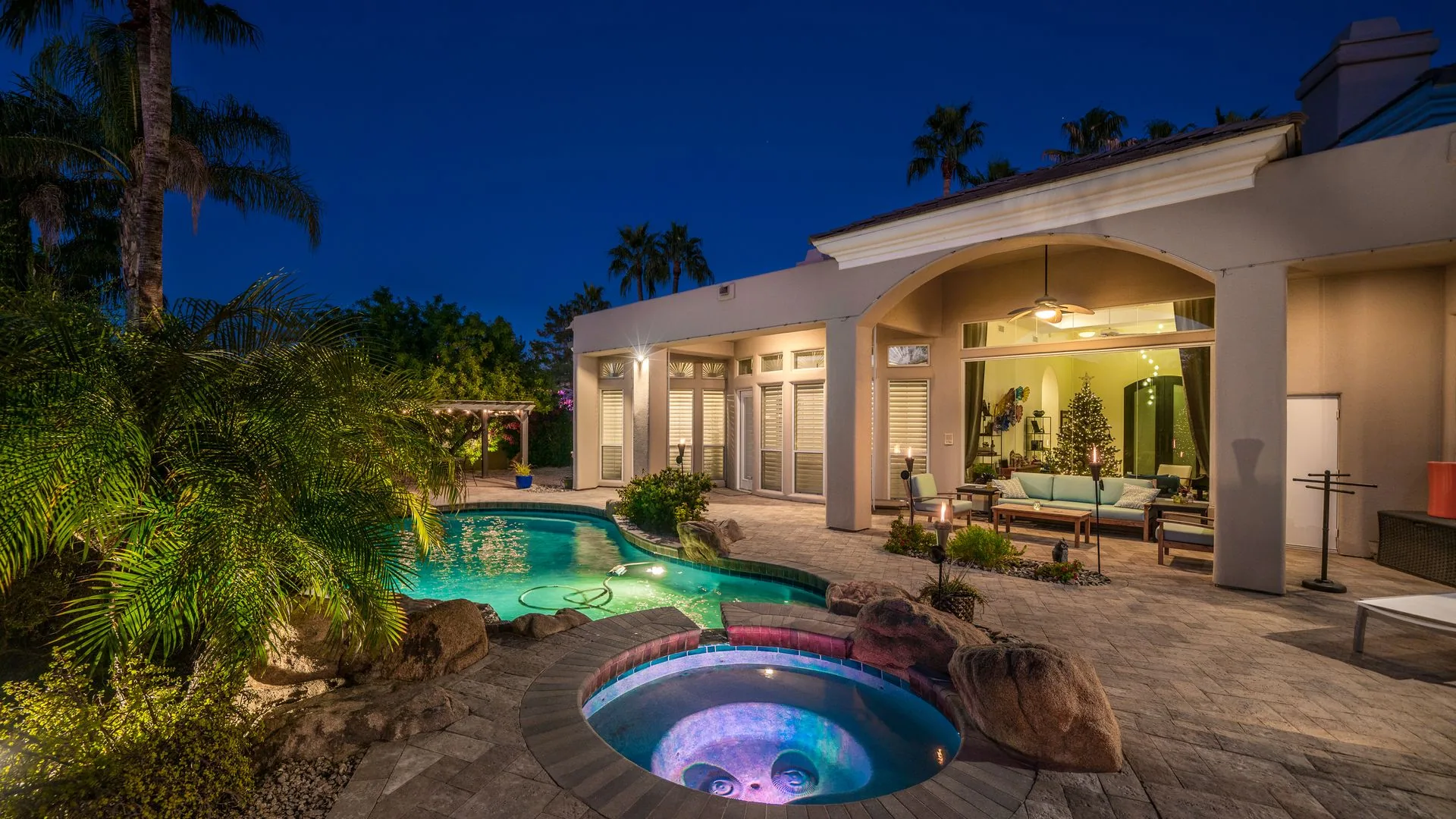
Solar vs. Low Voltage Lighting: What Works in Arizona
September 3, 2026 · By Diamond Cut Landscaping

Solar vs. low voltage lighting is one of those choices that seems simple until you live with it through a Phoenix summer. You have plenty of sun for charging, sure. You also have weeks of 110°F heat, dust that settles on everything, and monsoon weather that shows you pretty quickly which fixtures were built to last.
When you’re deciding how to light your yard, it helps to start with one question: what job do you need the light to do? Mark a walkway so nobody misses a step? Put a soft halo on a saguaro? Make the grill area actually usable after sunset? Those are different goals, and they do not always call for the same system.
Solar vs. low voltage lighting: what you are really choosing
Think of this as a “standalone” system versus a “connected” system.
Low-voltage LED lighting usually runs on 12 volts and ties back to a transformer connected to a GFCI-protected outlet. From there, wiring runs through planting beds, under pavers, along wall caps, or inside a pergola. When it’s designed into the landscape from the start, it feels clean and intentional because the wiring is hidden and the fixtures are placed as part of the overall plan.
Solar landscape lighting is self-contained. Each light has its own little solar panel and battery, charges during the day, then turns on around dusk. That makes solar quick to add and great for certain corners of a yard, but it also means every fixture has its own “personality” based on where it sits, how dusty the panel gets, and the condition of its battery.
Solar landscape lighting in Phoenix: where it shines, and where it struggles
Phoenix has no shortage of sunny days, so solar can absolutely make sense for small accent lighting. If you want a gentle glow along a path edge, a few dots near a planter, or a little definition around decorative rock, solar can check that box with minimal disruption.
The reality check is heat. Batteries and plastic lenses bake for months, and that constant stress can shorten battery life and reduce runtime. If you have ever noticed solar lights that look fine in spring and fade out early by late summer, that’s usually the combination of heat, battery wear, and dusty panels.
If you want a practical baseline for what typical solar fixtures are built to do, output ranges and common use cases for solar outdoor lights is a helpful reference before you buy.
Solar vs. low voltage lighting for Phoenix patios and outdoor kitchens
If you’re trying to make your patio feel like a real outdoor room, or you cook outside a lot, low voltage is usually the better fit. Why? Because you want the light to be consistent, not “pretty good if the battery had a good day.”
Low-voltage lighting is also easier to layer. You can mix path lights, step lights, uplights, and downlights, then keep the whole system on a timer or photocell. That’s how you get a yard that looks good and works well, without blasting everything with harsh brightness.
Planning matters, too. Wire routes are cleaner when we can tuck them under hardscape edges or inside framing. how low-voltage deck lighting is typically routed and installed gives you a good sense of why early planning pays off.
Low voltage lighting in Arizona: the “set it and forget it” advantage
In the Valley, the biggest benefit of low voltage is simple: it works the same way every night. Dusty week? Shaded side yard? Monsoon storm rolled through and left grit on everything? Your lights still come on at full output because they are powered by the transformer, not a tiny battery.
Low-voltage systems also give you more control without making life complicated. Depending on the transformer and layout, you can set zones, adjust timing by season, and choose warmer color temperatures that feel comfortable on a summer night.
If you’re curious what a professionally planned system looks like, our low-voltage LED lighting services in Phoenix page walks through the types of fixtures and layouts we build into full outdoor living projects.
Solar vs. low voltage lighting costs in Arizona: what you can expect
Solar is usually cheaper upfront because you’re not paying for trenching, wiring, and a transformer. For a quick upgrade, that is appealing. The catch in Phoenix is that the long-term cost can sneak up on you if you start replacing batteries or entire fixtures after one to three summers.
Low voltage costs more to install, but you’re paying for a system that’s meant to run reliably for years. In the Phoenix market, a basic professionally installed low-voltage setup for a small front yard or backyard zone often starts around $1,500 to $3,500, while larger properties or fully layered backyard lighting plans commonly land in the $4,000 to $10,000+ range depending on fixture count, controls, and how much hardscape we’re working around.
For a broader pricing comparison, typical cost differences between solar and low-voltage landscape lighting lines up with what we see locally: solar wins on day-one spend, and low voltage usually wins on performance and longevity.
When solar lighting is actually a smart move in the Valley
Solar is at its best when you want light in a place that’s a pain to wire. That might be a far corner of the yard, a small garden moment away from the house, or a finished area where you do not want to disturb pavers or concrete.
We also like solar for “bonus lighting,” the kind that adds charm without carrying safety pressure. In other words, it’s fine if it’s subtle. It’s not fine if it’s the only thing keeping someone from missing a step.
If you go solar in Phoenix, a few habits help it perform better:
- Give panels real sun, not filtered shade under a tree canopy or patio cover.
- Wipe panels occasionally, especially after dusty winds or monsoon season.
- Buy fewer, better fixtures instead of a big pack of low-cost lights that fade fast.
Why a hybrid lighting plan works so well in Phoenix
Most of the best-looking yards we build are not “all solar” or “all wired.” They are layered. You use low voltage where you need dependable light, and you sprinkle solar where it’s convenient and you’re mainly after ambiance.
- Choose low voltage for primary walkways, steps, patio seating, outdoor kitchens, and feature uplighting on trees or columns.
- Use solar for small accents in hard-to-reach spots, or where trenching would mean tearing up finished surfaces.
- Plan lighting with the build so wiring can be hidden in the right places from day one.
If you’re gathering ideas for what to light and how to combine fixture types, our backyard lighting ideas for Arizona outdoor living post is a good next step.
FAQ: Solar vs. low voltage lighting in Arizona
Is solar landscape lighting worth it in Phoenix?
Yes, when you treat it like accent lighting. Solar is handy for quick upgrades and areas that are difficult to wire. If you want dependable brightness for safety or for entertaining, low voltage is usually the better long-term choice.
Does Phoenix heat really shorten solar light battery life?
It can. Our summers put a lot of stress on rechargeable batteries, especially when fixtures sit in full sun all day and then try to run all night. That’s why many homeowners notice shorter runtimes or dimmer output after a couple of seasons.
Can you add low-voltage lighting to an existing yard?
Absolutely. Retrofitting is common. It’s usually easiest when it’s paired with another update like refreshing planting beds, adding a new patio section, or rebuilding a wall cap so we can hide wiring without making a mess of finished surfaces.
Which is better for steps and walkways?
Low voltage lighting. Those are “no-fail” areas. You want consistent, predictable light every night, not a fixture that’s bright one week and faint the next.
Conclusion
If you’re weighing solar vs. low voltage lighting in Arizona, match the system to the job. Solar landscape lighting is great for quick accents and spots where wiring is impractical, especially if you keep your expectations realistic in our heat. For the lighting that makes your outdoor space safer, more usable, and polished year-round, low-voltage LED lighting is the workhorse.
If you want help mapping out a lighting plan that fits your patio, planting, and the way you actually use your yard, we’re happy to walk it with you. Reach out through the Diamond Cut Landscape contact page to request a design consultation anywhere in the Phoenix metro.