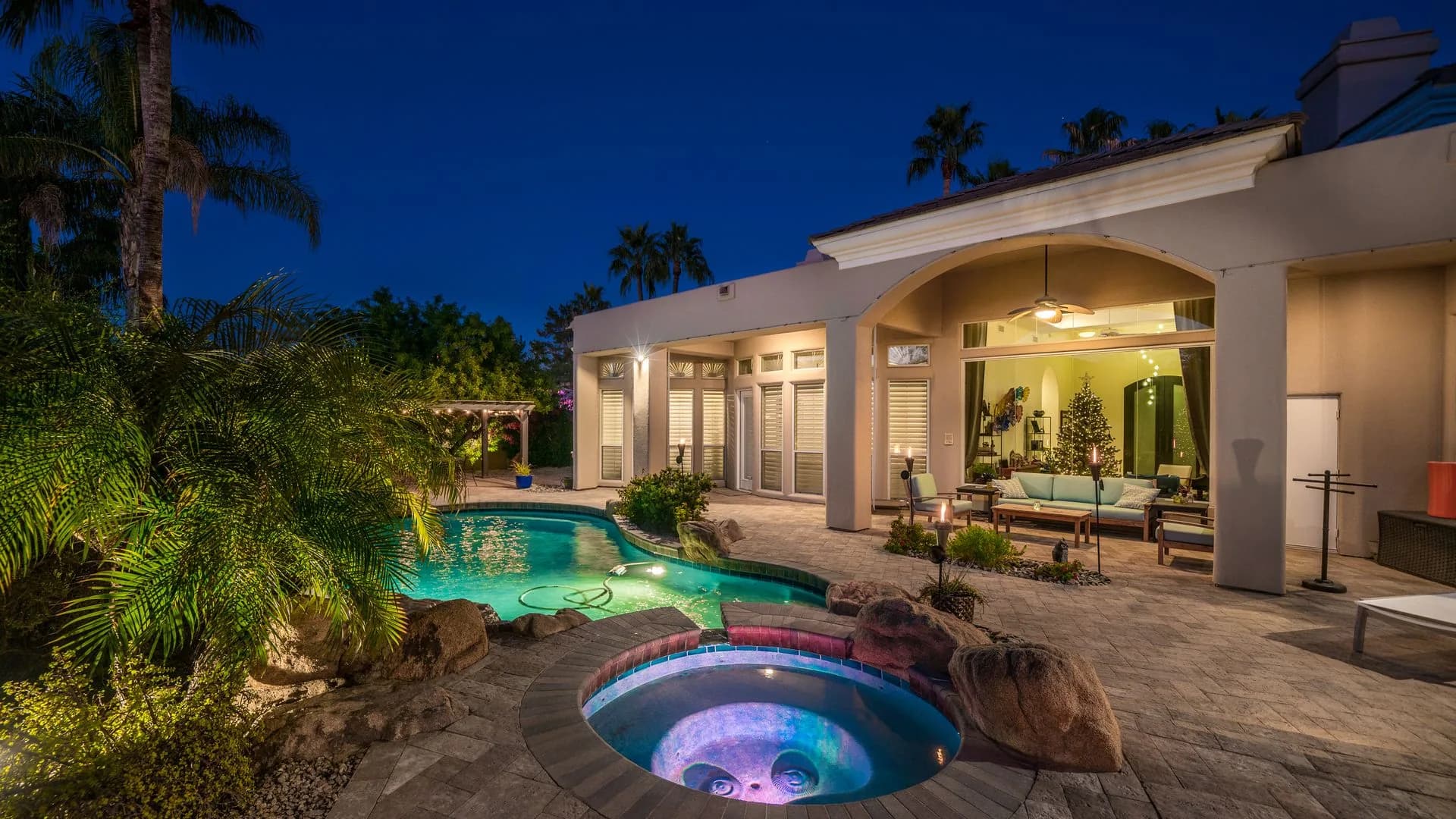
Tree Uplighting for Desert Trees and Cactus in Phoenix
November 16, 2026 · By Diamond Cut Landscaping

Tree uplighting for desert trees and cactus in Phoenix is one of those upgrades that can make your whole yard feel more “finished” the first night you flip the switch. The Sonoran Desert does a lot of the design work for you already. Saguaros have natural ribbing, palo verdes twist and fork in interesting ways, and ocotillo throws wild shadows when you hit it with the right beam. Your job is not to blast everything with light. It’s to pick the right plants, aim carefully, and let the texture do the talking.
This guide walks you through the stuff that actually matters in the Phoenix metro: where to place fixtures, how bright to go without turning your yard into a spotlight show, and how to keep glare out of your eyes and your neighbors’ windows. If you want help designing a full system that ties together patios, paths, planting beds, and architecture, take a look at our low-voltage LED landscape lighting service.
Tree uplighting in Phoenix: what it is and why it looks so good on desert plants
Tree uplighting is simple in concept. You set a fixture at ground level and aim it up into a trunk, a canopy, or the ribs of a cactus. The reason it works so well in Phoenix is that desert plants have strong structure. They are not “leafy blobs.” They have lines, negative space, and shapes that light can carve into.
Done well, tree uplighting gives you:
- Depth that your landscape doesn’t have in daylight alone
- Better curb appeal without adding more stuff to the yard
- Useful nighttime navigation when it’s layered with path and patio lighting
Also worth saying out loud: in Phoenix, lighting is not just a “party feature.” It’s a comfort feature. When it’s still 100 degrees at 9 p.m., you actually use the yard after dark. Lighting makes that feel intentional instead of improvised.
Tree uplighting placement basics (so your yard doesn’t look overlit)
Most lighting problems we see come from a few small missteps: fixtures pushed too close to the trunk, beams that are too wide, or lights aimed too high so you see the glare instead of the plant.
A practical starting point for tree uplighting placement is:
- Distance from trunk: about 1 to 6 feet, depending on size and spread
- Aim: roughly 30 to 45 degrees upward
- Goal: light the trunk and branching, not the sky
This matches the field-tested guidance in tree lighting placement recommendations, and it lines up with what works on our typical Phoenix plant palette.
Quick, real-world adjustments we make all the time:
- Twisty desert trunks like mesquite, palo verde, and ironwood often look better with the light a bit closer so you catch the bark texture and the branching right away.
- Tall narrow shapes like palms and columnar cactus usually need a tighter beam, otherwise you spill light into gravel and walls and it starts to feel messy.
Tree uplighting for cactus in Phoenix: saguaros, ocotillo, and agave without the “spotty” look
This is where Phoenix yards can look amazing with very little effort. A saguaro uplight that hits the ribs cleanly can look like sculpture. Ocotillo can throw shadows that read like art on a stucco wall. The catch is that cactus shapes are unforgiving. A sloppy beam shows up fast.
- Saguaro: One narrow spot can work on a smaller cactus, but larger saguaros almost always look better with two lights from different angles. It evens out the ribs and keeps you from getting a single bright stripe.
- Ocotillo: Start with a slightly wider beam so you pick up multiple canes, then adjust the fixture until the glare disappears from your usual viewpoints.
- Agave and accent clusters: Keep it modest. A small warm uplight can make the plant look crisp without lighting up the whole bed.
If you’re trying to decide what to light first, choose one “hero” cactus near the entry or along the main view from your patio doors. Let the rest of the yard support it. Contrast beats brightness almost every time.
How many fixtures per tree? (Hint: it’s not always about more lumens)
One uplight can be enough for a young tree or a simple trunk. Mature trees around the Valley are different. Mesquites can spread wide, and if you light a big canopy from only one side, you’ll get heavy shadows and that half-lit look.
A common range is 2 to 4 uplights for larger trees, spaced around the trunk so the light feels balanced. That approach lines up with the practical advice in this overview of lighting techniques for trees.
One rule we use on-site: if the tree looks uneven from the street, your next move is usually a second fixture from a different angle, not a brighter bulb. Several lower-output lights tend to look calmer than one high-output light trying to do everything.
Lumens and beam angles for tree uplighting in Phoenix (a simple starting point)
Phoenix yards have a few quirks that change how bright lighting feels. Light bounces off stucco. Decomposed granite reflects more than you’d think. Dust in the air can make cool, intense lighting feel harsh. So while we can talk about lumen ranges, the best plan is to start conservative and adjust.
As a baseline, the lumen ranges below are a good place to begin, similar to the guidance in this tree uplighting lumen guide.
| Desert feature | Typical approach | Common lumen range (starting point) |
|---|---|---|
| Small accent tree (young desert willow, small palo verde) | 1 uplight, medium beam | About 300 lumens |
| Medium canopy (fan palm, mature ornamental) | 1 to 2 uplights, watch glare | About 500 lumens per fixture |
| Large shade tree (mature mesquite, ironwood) | 2 to 4 uplights, cross-lighting | 1,000+ total system lumens |
| Large saguaro or specimen cactus | 1 to 2 narrow spots, often from two angles | Often 300 to 800 per fixture |
Beam spread matters as much as lumens. Narrow spot beams help you stay on the plant, especially for cactus and palms. Wider flood beams are helpful for broad canopies, but they need careful aiming so you are not throwing light into upstairs windows or across the property line.
Warm LEDs, heat, and monsoons: what holds up in Arizona
In our climate, you want lighting that can handle heat, dust, and sudden summer storms. Low-voltage LED systems are the standard for a reason. They run efficiently, they are easy to control, and they do not cook themselves the way older-style lamps can when fixtures sit in full sun all day.
For color temperature, we usually steer you toward 2700K to 3000K warm white. It plays nicely with desert greens and silvery tones, looks natural against tan stucco, and feels comfortable around a patio. Cooler light can make a desert yard look washed out, and it tends to read brighter than you want once the air gets dusty.
Next-level looks with tree uplighting: cross-lighting, silhouetting, and moonlighting
If you want your yard to feel designed instead of just “lit,” layering is the move. You do not need a complicated plan, but you do want variety. A single technique repeated everywhere can look flat.
- Cross-lighting: Two uplights from different angles to reduce harsh shadows and make trunks look more dimensional.
- Silhouetting: Put the light behind a cactus or spiky plant so the shadow lands on a wall. This can look especially sharp in Phoenix where stucco walls give you a clean backdrop.
- Spotlighting: A tight beam on one specimen plant near the entry to create a focal point.
- Moonlighting: Downlighting from within a canopy for soft, useful light on patios and walkways.
If you’re curious about how these methods work together, this guide to tree lighting techniques does a good job explaining the core ideas.
Glare control and being a good neighbor in the Valley
Great uplighting is mostly invisible as a “light source.” You notice the plant, not the fixture. If you can see the lamp from your favorite patio chair, it will bug you eventually. Same for your neighbors, especially in tighter lots or homes with second-story windows.
Here’s what we aim for when we design and install systems:
- Hide the source: Use shrouds and shields so the beam stays on the plant.
- Check the common views: Walk the yard. Look from the street, from the front window, and from patio seating. Adjust until the glare disappears.
- Use a schedule: Timers or smart controls keep the yard looking good early, then dial it back late night.
- Keep it warm: Warm white generally feels softer and less intrusive than cool white.
How tree uplighting fits into a complete outdoor living build in Phoenix
Lighting is easiest when it’s planned alongside the rest of your yard. If you’re adding a paver patio, pergola, outdoor kitchen, or new planting, you can route wiring cleanly, keep transformers accessible, and avoid trenching through existing irrigation later.
When you’re ready to think beyond a few fixtures and into a whole-yard plan, our landscape design services in Phoenix help you lay out lighting zones that match how you actually use the space. Entry and curb appeal, patio lounging, cooking and dining, side-yard access, pool circulation, and dark corners that need a little help.
If you want inspiration for front yard layering, you can also borrow ideas from our front yard lighting ideas for Phoenix curb appeal, then apply the same logic to your trees and specimen cactus.
FAQ: Tree uplighting for desert trees and cactus in Phoenix
What color temperature looks best for tree uplighting in Phoenix?
For most desert landscapes, warm white around 2700K to 3000K looks the most natural. It flatters palo verdes, mesquites, saguaros, and stucco finishes without feeling harsh.
How far from the trunk should you place an uplight?
Start around 1 to 6 feet from the trunk, then adjust based on the beam spread and what you see from your main viewing spots. If you get a hot spot, back it off. If the tree looks dim and flat, bring it in slightly or add a second fixture from another angle.
How bright should uplighting be for desert trees?
A useful starting point is about 300 lumens for small trees and around 500 lumens per fixture for medium trees. Large trees usually look better with multiple fixtures and 1,000 lumens or more total across the group. In Phoenix, spreading light out tends to look better than one super bright beam.
Can you uplight a saguaro without making it look striped?
Yes. Use a narrow, controlled beam and consider two fixtures from different angles on larger saguaros. You’re aiming for even texture on the ribs and arms, not one bright streak.
How do you prevent glare and light spill into windows?
Use shields or shrouds, aim the fixture so the lamp is not visible from seating and windows, and test the lighting from the street and neighboring sightlines. A timer schedule also helps keep late-night spill to a minimum.
Conclusion: a cleaner, calmer way to light your desert landscape
Tree uplighting works in Phoenix because your plants already have strong shape and texture. With smart placement, warm LEDs, controlled beams, and a little restraint, you can make saguaros, palo verdes, and palms look sharp after dark without glare or wasted light.
If you want help picking fixture locations and building a system that fits your yard and holds up in Arizona weather, reach out through our Diamond Cut Landscape contact page. We’ll help you get a lighting plan that looks good from the curb, feels comfortable on the patio, and stays focused on the plants you actually want to show off.